

All Post
Battery & Charging System Check: The Winter Killers Explained
Oct
Battery & Charging System Check: The Winter Killers Explained
The short answer: winter no-start failures come from three things at once — the battery loses capacity, the starter demands more current, and the charging system was already marginal. Run five checks before the first freeze: resting voltage (12.4–12.7V is healthy), cold cranking amps measured against the rating on the label, cranking voltage (must stay above 9.6V), alternator output under load (13.8–14.4V), and parasitic drain (under 50 mA). A battery that passes all five in October usually survives to spring. A battery that fails one of them will fail on the coldest morning of the year — and it will fail without warning.
Battery failures look sudden because they are sudden *for the driver*. Chemically, the decline starts months earlier: plates shed active material and the reserve that covered a worn starter motor in September is spent by December. Nothing announces it until the morning the engine turns over slowly and then stops.
Hence the pre-winter check. It turns a roadside event into an afternoon of measurement, using a multimeter and — for one test — a conductance tester most parts stores loan out free.
Why Winter Kills Batteries: Capacity Down, Demand Up
Cold weather attacks from both directions, and the two effects compound.
- Capacity falls. A lead-acid battery delivers roughly 60% of its rated capacity at 0°C, and only about 40% at -18°C.
- Cranking demand rises. Cold engine oil is far thicker, so the starter has to turn a stiffer engine while drawing more current than it did in summer.
- Charging gets harder. A cold battery accepts charge more slowly, so short winter commutes can leave it below full for weeks at a time.
A chemically healthy battery has margin to absorb all three; a four-year-old battery usually does not. That is why failures cluster — the first genuinely cold morning takes out thousands of batteries across a region on the same day.
One more risk catches people out: a discharged battery freezes far sooner than a charged one. Electrolyte in a full battery will not freeze until roughly -60°C, but one left at 20% state of charge can freeze near -10°C, cracking plates and case. That battery is scrap, not discharged.
The Five-Point Battery and Charging System Check
Run these in order. Each test answers a question the previous one cannot.
1. Resting Voltage and State of Charge
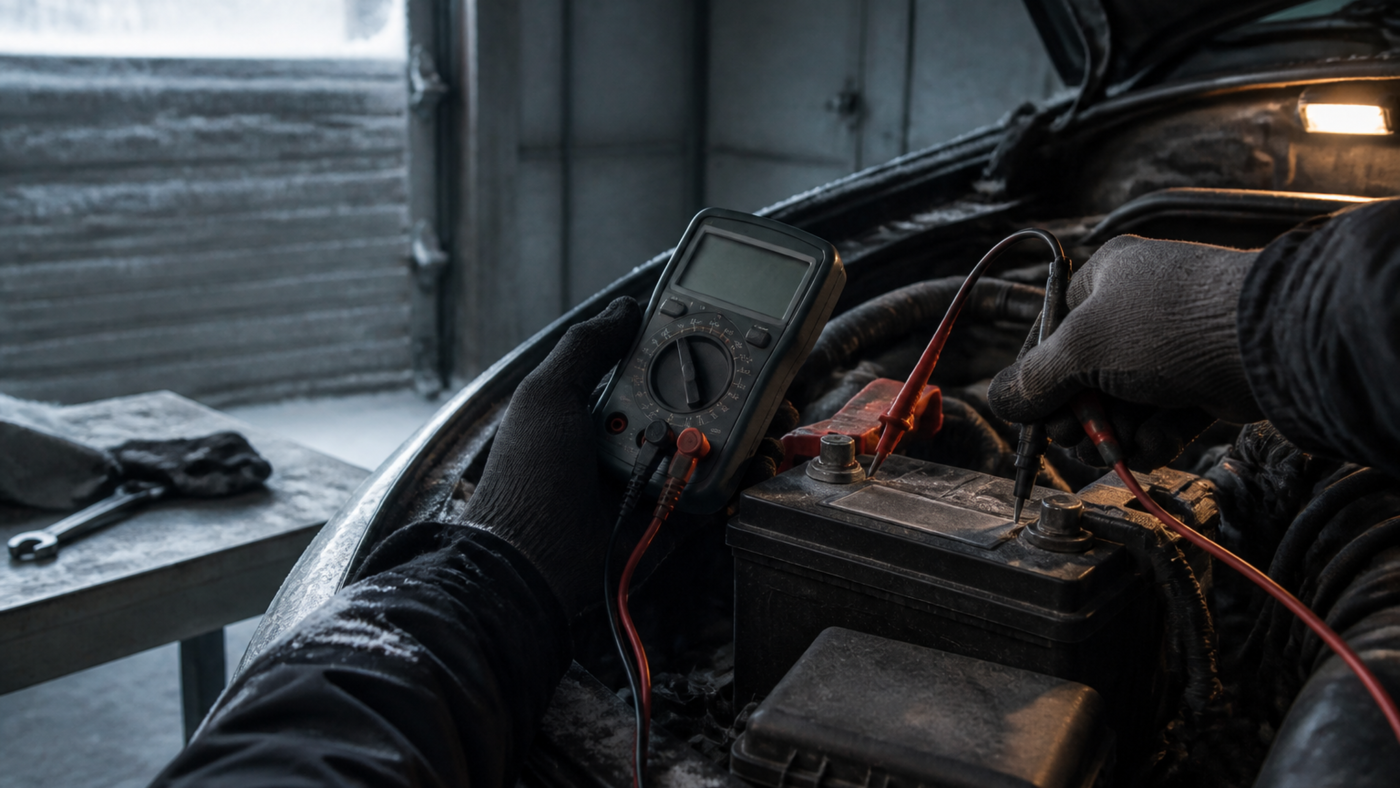
Let the battery rest — engine off, doors closed, key out. Surface charge from a recent run or charger will read high, so switch on the headlights for 30 seconds and let the voltage settle before measuring.
- 12.6V — effectively 100% state of charge
- 12.4V — roughly 75%
- 12.2V — roughly 50%
- Below 12.0V — discharged; recharge it before testing anything else
A reading below 12.2V after an overnight rest means the battery is undercharged or being drained — the next two tests tell you which.
2. Cold Cranking Amps (CCA)
Voltage tells you how much charge is present; it says nothing about how much current the battery can still push. A conductance tester compares the battery’s measured cold cranking amps against the rating printed on the label. A battery that tests below about 70% of its rated CCA is a winter risk even if it starts the car perfectly today — that is precisely the battery that dies at -15°C.
3. Cranking Voltage and Starter Draw
Measure voltage at the battery terminals while the engine is cranking, and watch the lowest number, not the average. Cranking voltage should stay above 9.6V. If it collapses below that while the battery passed tests 1 and 2, the battery is failing under load, or something is demanding too much current.
Typical starter draw is roughly 150–250A on a four-cylinder, and higher on large V8s. Unusually high draw points to a worn starter, a failing cable, or mechanical drag such as oil far thicker than the engine was designed for.
4. Alternator Output Under Load
Start the engine and switch on the headlights, the heater blower, and the rear defroster — the winter load package. Measure at the battery terminals: 13.8–14.4V is healthy at idle and up to about 1,500 rpm. Below 13.2V under that load, the alternator is not keeping up, and the battery is paying for the shortfall.
A failing rectifier diode is subtler: charging voltage can look normal while the alternator feeds AC ripple into the system, damaging electronics over time. More than about 0.5V AC ripple on a tester indicates a problem.
5. Cables, Terminals and Parasitic Drain
Two last items, both cheap to fix and both frequent causes of winter no-starts:
- Voltage drop across connections. Clean, tight terminals and grounds should show almost no drop. A drop above roughly 0.1V across a single connection is enough to slow cranking, and it mimics a failing battery.
- Parasitic drain. With everything off and all modules asleep — allow 20 to 40 minutes — a normal car draws under 50 mA (0.05A). Above 100 mA, something is not sleeping, and that constant drain is what leaves a marginal battery flat after a cold weekend.
Reference Values: Healthy vs. Failing
| Test | How to measure | Healthy | Act on it |
|---|---|---|---|
| Resting voltage | Multimeter across terminals, engine off, surface charge removed | 12.4–12.7 V | Below 12.2 V after a full charge |
| Cold cranking amps | Conductance tester vs. the CCA rating on the label | 80–100% of rated CCA | Below 70% of rated CCA |
| Cranking voltage | Lowest reading while cranking | Above 9.6 V | Below 9.6 V |
| Charging voltage | Engine running, lights and blower on | 13.8–14.4 V | Below 13.2 V |
| AC ripple | Tester across battery, engine running | Under 0.5 V AC | 0.5 V AC or more |
| Parasitic drain | Ammeter in series, after modules sleep | Under 50 mA | Above 100 mA |
Warning Signs Your Battery Will Not Survive Winter
- Slow cranking on cold mornings that improves once the engine is warm.
- Headlights that brighten when you rev the engine — a classic charging-system sign.
- Battery age past four years. Most flooded batteries last three to five; fewer in hot climates.
- A swollen case or any sulfur smell. The battery is finished, not discharged.
- Repeated jump-starts. The second one is a signal, not a solution.
What to Do When a Test Fails
If tests 1 and 2 fail, replace the battery. Match the group size and meet or exceed the original cold cranking amp rating, especially on start-stop cars and diesels. AGM batteries cannot be swapped for flooded batteries where AGM is specified, because the charging profile differs.
If test 4 or 5 fails, the battery is probably fine and the vehicle is the problem — replacing it on a car with a weak alternator or a 150 mA drain buys six weeks and a second tow.
For workshops and distributors, winter is also a stocking decision: battery and charging work is the largest single winter category for roadside providers, and it arrives without an appointment. POCYBER’s automotive-electronics range covers charging hardware, including Type 1 (US) and Type 2 (EU) EV charging stations in the MB and OB series, for shops whose customers include plug-in vehicles. Trade buyers can use POCYBER’s wholesale program for electrical and ignition lines with flexible minimum order quantities and batch inspection before shipment.
FAQ
What voltage should a car battery read in winter?
A healthy, fully charged battery should read 12.4–12.7V at rest with the engine off and surface charge removed. Below 12.2V means it is undercharged or being drained. While the engine runs, charging voltage should be 13.8–14.4V.
At what temperature does a car battery lose capacity?
Capacity begins falling below about 10°C: a lead-acid battery delivers roughly 60% of its rated capacity at 0°C and about 40% at -18°C, which is why a battery that is marginal in autumn fails in winter.
How do I tell whether it is the battery or the alternator?
Test the battery at rest first. Low resting voltage after a full charge, plus cold cranking amps below about 70% of the label rating, means the battery is the problem. If the battery is healthy but charging voltage stays below 13.2V under load, the alternator is. High parasitic drain is the third possibility, tested separately.
Does a fully charged battery freeze in winter?
A fully charged lead-acid battery will not freeze until roughly -60°C. A discharged one is different: at around 20% state of charge it can freeze near -10°C — an ordinary winter night in much of North America and Europe.
Can I run this check myself without a load tester?
Yes, apart from the cold cranking amp test. A multimeter covers resting voltage, cranking voltage, charging voltage and cable voltage drop; a clamp ammeter covers parasitic drain. Many parts stores run a conductance test free, which fills the one gap.
—