

Every POCYBER part sold through an authorised channel is genuine, and parts that carry a security label can be checked in under a minute. This page explains how to run that check, what each result means, and how to spot counterfeit auto parts — with or without a label.
Product Verification
Enter the code from your package label below. You will get a result immediately, including how many times the code has been checked.
Well done! You successfully read this important alert message.
Query Code verified successful!
Your Query Code: 4520938853 has been verified 3 Times!
Locate the security label, like the one shown below, on the package and remove the scratch off coating to see the code. Example:
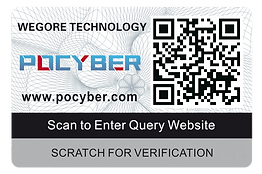
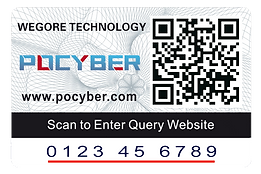
Check Your Code in 60 Seconds
- Find the security label on the packaging. Scratch off the silver coating to reveal the code.
- Enter the code in the box above, exactly as printed.
- Add your email address, then select Submit to Verify.
- The result tells you whether the code is genuine, and how many times it has been queried.
What Your Result Means
| Result | What it means | What to do next |
|---|---|---|
| Verified — first check | The code is genuine and has not been queried before. | Nothing further. |
| Verified — checked before | The code is genuine, but it has been queried before. A code that has already been used can indicate that packaging was re-used. | Contact us if the check count looks wrong. |
| Not verified | The code is not in our records. On its own this does not mean the part is counterfeit — codes can be mistyped, and labels can be damaged in transit. | Re-enter the code carefully, then contact us before returning the part. |
| No label on the package | Many genuine parts ship without a security label. | See "Why Some Genuine Parts Have No Code" below. |
Why Some Genuine Parts Have No Code
Security codes are applied to products sold offline, in the countries and regions listed at the end of this page. If you bought your part through our online store, or through an authorised retailer or distributor, the part is genuine whether or not the packaging carries a label. The code is one verification route — it is not the only one.
How to Spot Counterfeit Auto Parts — A Six-Point Check
- A price that is far below the market. Counterfeit parts are priced to be irresistible. If a quote is a fraction of what every other supplier charges for the same part number, treat the price itself as the first warning sign.
- Packaging that almost matches. Fakes copy the box, not the tolerances. Look for printing that is slightly off-register, fonts that differ from a genuine sample, and labels that are crooked or on the wrong panel.
- No traceable part number, or a number that does not resolve. A genuine part number should be searchable and should match the application you need. Counterfeiters often reuse a real number on a part that will not fit.
- A seller who will not say where the part came from. Ask whether they are an authorised distributor, and ask who honours the warranty. A seller who cannot name the warranty holder is not standing behind the part.
- Warranty terms that only exist verbally. A real warranty is written down. Ask for the term in writing, and ask where a claim is processed — including who pays return freight if the part is wrong.
- Fitment that is "close enough". Genuine parts fit first time. If a part has to be forced, modified, or is sold with a disclaimer that it "may require adjustment", stop and verify it before you install it.
For independent consumer guidance on counterfeits, see the U.S. Federal Trade Commission’s consumer advice at consumer.ftc.gov.
If You Think You Have Received a Counterfeit Part
- Stop, and photograph the part, the packaging and the label before returning anything.
- Run the security code check above, if your packaging carries a code.
- Contact us at support@pocyber.com with your order reference and the photographs. We will confirm whether the part came from us.
- If the part did not come from an authorised POCYBER channel, report it. In the US, consumer fraud can be reported to the Federal Trade Commission at consumer.ftc.gov.
Frequently Asked Questions
How do I verify that my POCYBER part is genuine?
If your packaging carries a security label, scratch off the coating and enter the code on this page. You will get an immediate result, and you will see how many times the code has been checked. If your part was bought through our online store, or through an authorised retailer or distributor, it is genuine whether or not the packaging carries a label.
There is no security label on my package. Is my part counterfeit?
No. Security codes are only applied to products sold offline, and only in the countries and regions listed on this page. Products bought through our online store, or through an authorised retailer or distributor, are genuine whether or not the packaging carries a label.
The result says my code has already been checked. What does that mean?
It means the code is genuine, but it has been queried before. That can happen for innocent reasons, but a code that has already been used can also indicate that packaging has been re-used. If the check count looks wrong to you, contact us with your order reference before returning the part.
My code came back as not verified. Is the part counterfeit?
Not necessarily. A code can fail because it was mistyped, because the label was damaged, or because packaging was re-used. Re-enter the code carefully, and if it still does not verify, contact us before returning the part so we can confirm whether it came from an authorised channel.
Which countries does the security code cover?
The code programme covers products sold offline across Asia, Europe, Africa, South America and Oceania. The full country and region list is at the end of this page. If your country is not on that list, your part will not carry a code.
What should I do if I think I have bought a counterfeit auto part?
Photograph the part, the packaging and the label, then run the security code check if your packaging has one. Contact us at support@pocyber.com with your order reference so we can confirm whether the part came from an authorised channel. If it did not, you can report consumer fraud to the Federal Trade Commission at consumer.ftc.gov.
Sourcing Parts for a Shop?
Trade pricing, an 18-month warranty and small-batch sourcing from 20 pieces are all on the Trade Club page. If you are comparing supply routes, our MOQ comparison for Alibaba, US distributors and trade programs sets out what each route actually requires.
The security code applies to products sold in these countries or regions.
Asia: India, Bangladesh, Chinese mainland, Hong Kong, Taiwan, Macau, Pakistan, Sri Lanka, Nepal, Myanmar, Maldives, Kuwait, Iran, Israel, Yemen, Oman, Qatar, United Arab Emirates (UAE), Bahrain, Iraq, Saudi Arabia (KSA), Jordan, Vietnam, Cambodia, Laos, Brunei, Indonesia, Singapore, Philippines, Thailand, Malaysia
Europe: Turkey, Albania, Bulgaria, Belarus, Czech Republic, Poland, Romania, Russia, Slovenia, Slovakia, Serbia, Ukraine, Estonia, Latvia, Azerbaijan
Africa: Algeria, Egypt, Lybia, Morocco, South Africa, Tunisia, Zimbabwe, Kenya, Mauritius
South America: Paraguay, Suriname
Oceania: Australia, New Zealand