

All Post
Winter Car Maintenance: Spark Plugs & Ignition Coils Checklist
Sep
Winter Car Maintenance: Spark Plugs & Ignition Coils Checklist
The short answer: winter ignition maintenance is five checks — read the spark plugs, measure and correct the gap, test coil primary and secondary resistance against the OEM window, inspect the coil boots for carbon tracking, and confirm cranking voltage stays above 9.6 V. Replace copper plugs at 20,000–30,000 miles, platinum at 60,000 and iridium at 60,000–100,000 miles; replace a coil when resistance drifts more than 20% from spec, when the housing is cracked, or past roughly 80,000–130,000 miles.
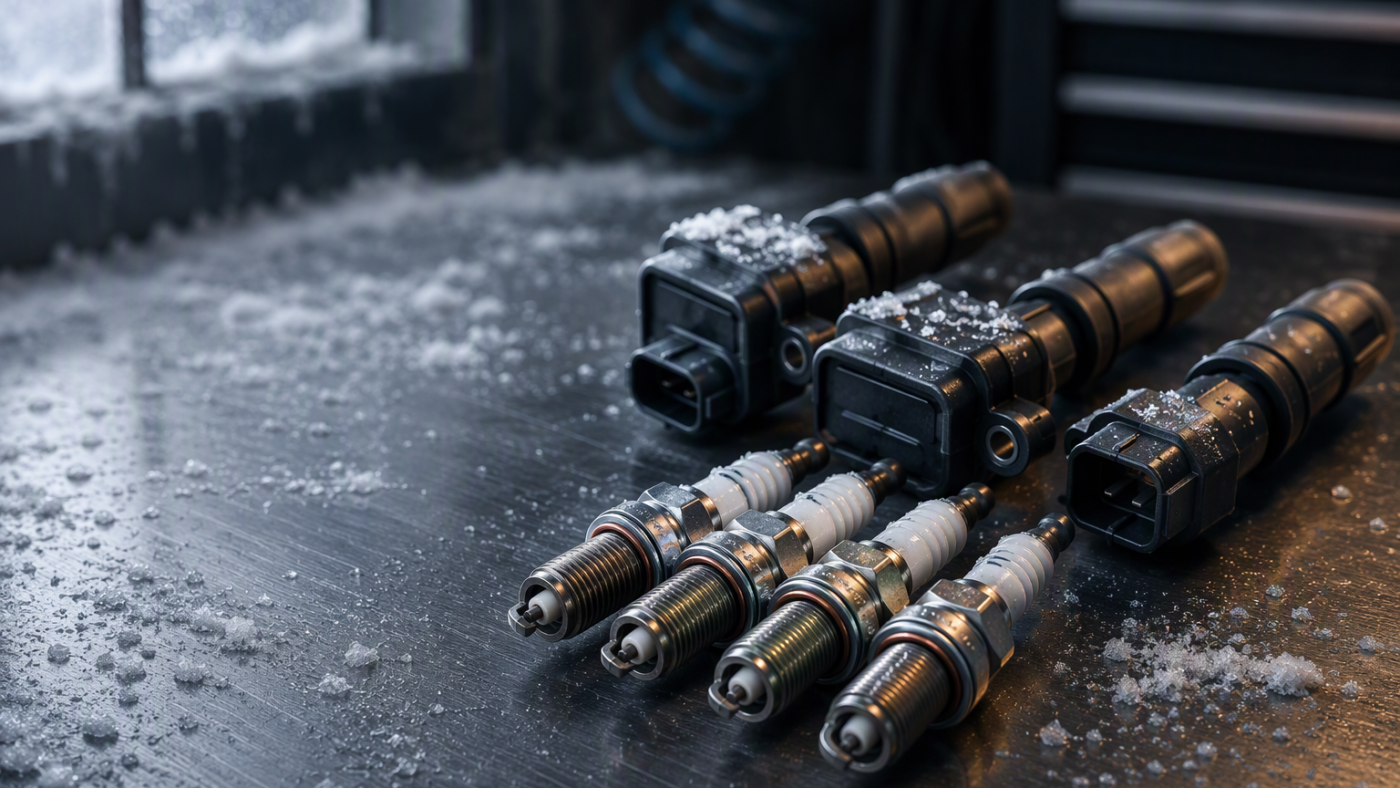
Winter does not break ignition systems — it exposes them. A coil that ran comfortably inside its margin all summer sits outside that margin on the first morning at -15°C, and a plug with an eroded gap demands more voltage than a cold, half-discharged battery can supply.
Why Cold Weather Punishes the Ignition System
Three changes happen at once, and all three push the same way.
- Voltage demand rises. Dense cold air raises the voltage needed to jump the gap — several kilovolts more at -15°C than at 25°C.
- Available voltage falls. A lead-acid battery delivers roughly 60% of rated capacity at 0°C and about 40% at -18°C, while cold oil makes the starter draw more current.
- Insulation weakens. Coil windings and rubber boots embrittle with every heat cycle, and a hairline crack that is harmless in dry summer air becomes a path to ground in cold, damp air.
The signature result is a P0301–P0308 misfire that appears on the first cold morning and vanishes by lunchtime — an intermittent pattern routinely misdiagnosed as a fuel fault.
The Winter Spark Plug and Ignition Coil Checklist
1. Read one plug from each bank
Pull one plug per bank — all four on a four-cylinder — and compare them. Look for rounded, eroded center electrodes (the gap has opened and voltage demand is up), dry black soot (a rich mixture or a weak coil on that cylinder), oily fouling (valve guides or rings), or blistered white insulators (overheating). Light tan or grey is healthy.
2. Measure the gap — do not eyeball it
Use a wire-type gauge and compare against specification, typically 0.028–0.044 in (0.7–1.1 mm). Iridium and platinum plugs erode at roughly 0.001 in per 10,000 miles, so a plug at 80,000 miles may have opened by 0.008 in — enough to misfire in cold, damp air. If the gap is out of spec, replace the plug.
3. Test coil resistance against the OEM window
Measure both windings with a multimeter: primary typically 0.4–2.0 Ω, secondary 5,000–15,000 Ω. An open circuit is a failed coil, and a reading more than 20% outside OEM specification is a coil that will keep working — until the first genuinely cold morning. Test cold and again after ten minutes of running: a coil that measures inside spec cold but drifts when hot is failing from winding breakdown.
4. Inspect boots and look for carbon tracking
This is the most-missed fault on the list. Look for a thin dark line or powdery white track running down the boot — a carbonized path where spark energy escapes to ground instead of firing the cylinder. Any track, crack or hardened boot means replacement, and a thin film of dielectric grease on reassembly keeps moisture out of the well.
5. Verify cranking voltage and charging output
A weak battery produces every symptom of a weak ignition system. Resting voltage should read 12.4–12.7 V; below 12.2 V means plan a replacement. During cranking, below 9.6 V at the battery means the ignition is not receiving enough to fire reliably. With the engine running, alternator output should sit between 13.8 and 14.4 V.
6. Respect the specified heat range
Fitting a colder plug for winter is a persistent myth and usually a mistake — heat range controls how quickly the plug sheds heat to the cylinder head and changes combustion temperature. Cold-weather misfires come from worn plugs, eroded gaps, weak coils or low cranking voltage, not from heat range. Use the specified plug and torque it correctly; over-torquing crushes the sealing washer and can crack the insulator.
7. Scan stored misfire counters
Modern ECUs log per-cylinder misfire counters before triggering a fault code, which catches a developing fault while it is still intermittent. One cylinder climbing while the others stay flat points straight at that cylinder’s coil or plug.
Copper vs Platinum vs Iridium: What Matters in Winter
| Plug type | Service life | Gap erosion | Winter behaviour | Best fit |
|---|---|---|---|---|
| Copper | 20,000–30,000 miles | Fastest | Strong when new, but voltage demand climbs quickly | Older engines, annual tune-ups |
| Platinum | Around 60,000 miles | Moderate | Predictable, but measurably eroded by year three | Standard OEM replacement |
| Iridium | 60,000–100,000 miles | Slowest | Most stable gap, so cold-start voltage demand stays consistent | Cold climates, hard-to-reach plugs |
The practical conclusion is that condition matters more than type: a fresh copper plug out-performs a worn iridium plug. What iridium buys is a stable gap over a much longer interval — exactly the property that stops a car developing a cold-morning misfire three winters after its last service.
Replacement and Inspection Reference
| Component | What to check | Replace when |
|---|---|---|
| Spark plugs (copper) | Gap, electrode wear, deposits | 20,000–30,000 miles |
| Spark plugs (platinum) | Gap, electrode wear, deposits | Around 60,000 miles |
| Spark plugs (iridium) | Gap, insulator condition | 60,000–100,000 miles |
| Ignition coils | Primary and secondary resistance, housing | Over 20% off OEM spec, cracked housing, or 80,000–130,000 miles |
| Coil boots | Carbon tracking, cracking, hardness | Any visible track, crack or hardened boot |
| Battery | Resting and cranking voltage | Below 12.2 V at rest, or below 9.6 V cranking |
What to Do With a Confirmed Fault
Once a part fails the checks above, the repair itself is straightforward — the parts decision decides most of the outcome. Cold-weather performance depends on winding quality, insulation material and electrode geometry, not the label on the box. POCYBER builds direct-fit ignition coils and iridium spark plugs to OE specifications, published with cross-references and validated resistance windows, so you can match the exact part number your engine calls for. Compare fitments by vehicle in the ignition system range in our shop.
For Shops: Stock the Ignition Line Before the Freeze
One failed coil rarely produces one job — a misfiring cylinder fouls its own plug, and a shop that replaces only the plug sees the same car again three weeks later. Stocking coils, plugs and boots together lets you quote the correct repair the first time.
The deadline is the real constraint: overseas ignition components carry a 2–4 week manufacturing and freight window, and cold snaps compress a month of demand into about 72 hours, so the order belongs five to six weeks before the first expected frost. POCYBER’s wholesale program is built for that timing — flexible minimum order quantities for the long tail, batch inspection on ignition lines, published OE cross-references and global shipping with lead times quoted up front.
FAQ
How often should spark plugs be replaced for winter?
Follow the material interval: 20,000–30,000 miles for copper, about 60,000 for platinum, and 60,000–100,000 for iridium. If your vehicle is at or past that interval and cold weather is coming, replace the plugs now rather than waiting for a misfire.
Can worn spark plugs cause a no-start in cold weather?
Yes, usually as a contributor rather than the sole cause. A widened gap demands more voltage precisely when a cold battery delivers less, so the engine may crank strongly and still fail to fire. Slow cranking points to the battery; fast cranking without firing points to the ignition side.
Does a colder spark plug help in winter?
No. Heat range controls how quickly the plug transfers heat to the cylinder head, not how well it fires in the cold. A colder plug changes combustion temperature and can foul. Use the manufacturer-specified plug and replace it on schedule.
How do I tell whether the fault is the coil or the spark plug?
Swap the suspect coil to another cylinder and clear the code. If the misfire follows the coil, the coil is at fault. If it stays on the original cylinder, the plug, injector or compression is responsible.
What is the minimum battery voltage for a reliable cold start?
About 9.6 V at the battery while cranking. Expect less margin in severe cold, since capacity falls to roughly 60% of rated at 0°C and 40% at -18°C. Below that, the ignition may not fire consistently regardless of plug and coil condition.
Winter Is a Maintenance Season, Not a Repair Season
Ignition maintenance in autumn costs an afternoon. The same fault in January costs a tow, a diagnostic fee and a vehicle stuck in a bay during your busiest fortnight. Read the plugs, measure the gaps, test the coils, check the battery — four hours that decides how your winter goes.
—