

All Post
Why Your Car Misfires in Cold Weather: Causes, Fixes & Prevention
Sep
Why Your Car Misfires in Cold Weather: Causes, Fixes & Prevention
The short answer: a cold-weather misfire almost always comes from one of five places — a failing ignition coil, worn spark plugs, a weak battery, poor fuel delivery, or an air/vacuum leak. Cold air is denser and demands more ignition voltage, so components that were “just good enough” in summer cross the failure line the first frosty morning. Diagnose by code, then by component, and the fix is usually straightforward.
Few things are more frustrating than a car that starts fine in June and stumbles, hesitates, or shakes every cold morning in November. You’re not imagining it — cold weather genuinely stresses the ignition system. Here’s the physics, the five usual suspects, and how to fix each one.
What Does a Cold-Weather Misfire Feel Like?
A misfire means one or more cylinders failed to burn fuel properly. Symptoms:
- Rough idle for the first minute after a cold start, smoothing out as the engine warms
- Stumbling or hesitation when accelerating in the first few miles
- A flashing check-engine light (severe misfire — unburned fuel is entering the exhaust)
- Shaking or vibration at idle, especially noticeable at stoplights
- Poor fuel economy while the condition persists
If the light flashes, the misfire is actively damaging the catalytic converter — don’t drive far before addressing it.
The 5 Most Common Causes of Cold-Weather Misfires
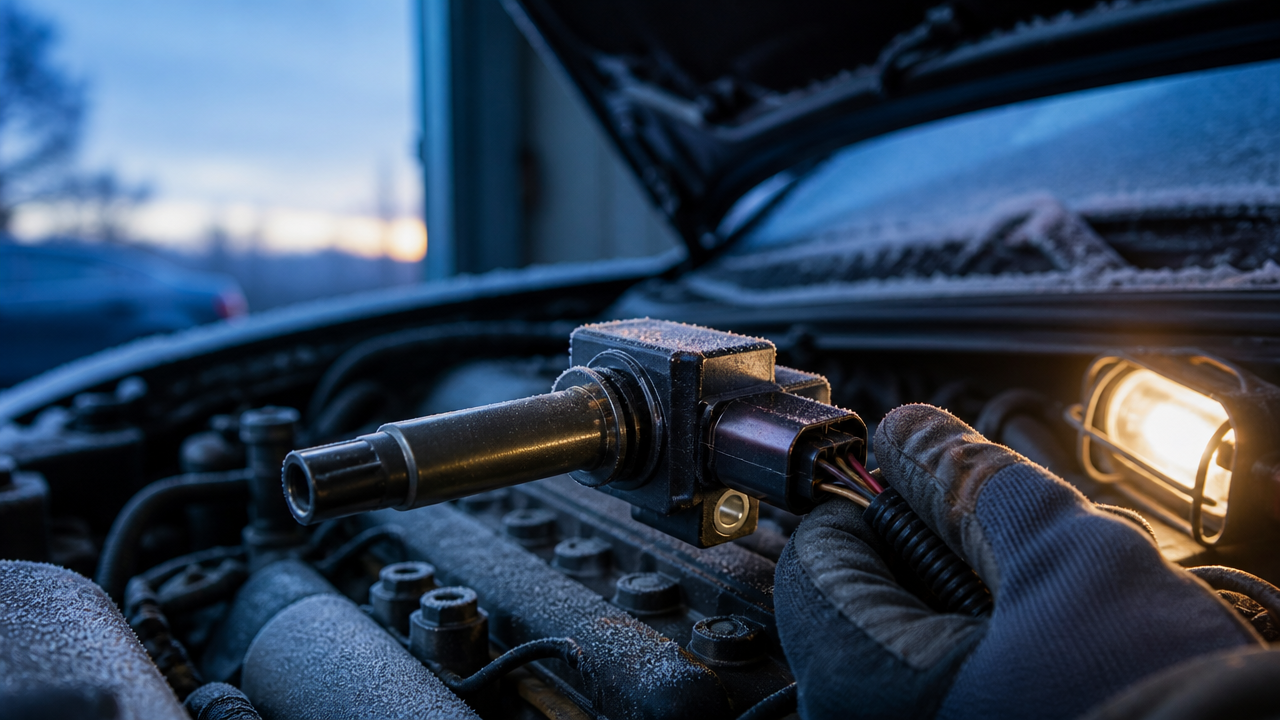
1. Failing Ignition Coil (Most Common)
The ignition coil steps battery voltage up to 20,000–45,000 volts to fire the plug. Cold weather attacks coils in two ways:
- Cold, dense air increases the voltage required to jump the spark plug gap.
- Thermal stress — the expansion/contraction cycle of heating and cooling — widens micro-cracks in the coil’s insulation, letting voltage leak to ground instead of the plug.
The classic signature: misfire on a cold start, code P0302/P0304 etc. (specific cylinder), and it sometimes clears once the engine bay warms up — which is exactly why it’s ignored all summer.
Fix: Test the coil with a multimeter (compare primary/secondary resistance to spec) or swap it with a known-good cylinder. If confirmed, replace — and most workshops replace plugs at the same time. Direct-fit coils like POCYBER’s ignition coil range match OE specifications and are built to hold stable output at low temperatures.
2. Worn or Fouled Spark Plugs
A spark plug’s job gets harder in winter: it must fire through denser air with a weaker mixture. Two failure modes:
- Widened gap — normal electrode wear increases required voltage; winter pushes it past the coil’s limit.
- Carbon fouling — cold starts run rich, and carbon on the insulator provides an easier path to ground than the electrode gap.
Fix: Inspect plugs. Worn electrodes, black soot, or oil fouling = replacement. Check the spark plug selection guide in our shop — iridium plugs hold their gap far longer than copper, making them the practical winter choice.
3. Weak Battery or Charging System
Voltage is the foundation of the whole ignition event. A battery that’s lost capacity (below 12.4V at rest) drops cranking speed, and a weak charge during startup means the coil receives less than optimal voltage precisely when it needs the most.
Fix: Load-test the battery; verify alternator output is 13.8–14.4V with the engine running. A $20 multimeter does both tests.
4. Fuel Delivery Problems
- Clogged or cold-cracked fuel injectors — poor atomization creates a weak, hard-to-ignite mixture.
- Old fuel — gasoline that sat through summer has lost volatile compounds, making cold starts and cold running harder.
- A weak fuel pump can’t hold pressure overnight, causing a long crank then misfire.
Fix: Add a fuel-system cleaner before the first cold snap, replace the fuel filter if it’s past interval, and don’t let the tank sit near-empty in winter (condensation forms).
5. Air Intake or Vacuum Leaks
Cold air is denser, which leans out the air/fuel mixture. A small vacuum leak — cracked PCV hose, intake gasket, or loose boot — that was borderline in summer becomes a lean-misfire in winter.
Fix: Smoke-test or spray carburetor cleaner around suspect hoses while idling; if the RPM changes, you’ve found the leak.
How to Diagnose a Cold-Weather Misfire (Step by Step)
Read the codes with an OBD-II scanner. P0301–P0308 = specific cylinder misfire; P0300 = random/multiple misfire.
Check the basics first — battery voltage, then air filter, then plugs.
If the code points to one cylinder, swap its coil with a neighboring cylinder, clear the code, and re-test. If the misfire follows the coil, the coil is the culprit.
If the misfire is random or moves around, the problem is systemic: fuel pressure, vacuum leak, or intake air.
Confirm before replacing — an afternoon of testing beats a parts-cannon approach.
Prevention: The Winter Misfire Prevention Checklist
- Replace spark plugs and coils at or before their service intervals, not after symptoms appear
- Keep the battery topped up — drive weekly or use a maintainer if the car sits
- Run a fuel system cleaner in October and keep the tank at least half full
- Inspect vacuum hoses and the intake boot before cold weather
- For shops: stock ignition coils and iridium plugs *before* the first freeze — customer demand spikes the same week temperatures drop
Why This Matters for Repair Shops and Wholesale Buyers
Cold-misfire season is the single most predictable service wave of the year. Workshops that pre-stock ignition components serve customers the same week the complaint appears; those that order after demand spikes wait on backorders. If you buy wholesale, POCYBER’s wholesale program offers bulk pricing on ignition coils, spark plugs and engine parts, with quality inspection and global logistics to keep your shelves ready for winter.
FAQ
Why does my car misfire only in cold weather?
Cold air is denser and requires higher ignition voltage. Worn spark plugs and aging ignition coils that worked marginally in summer drop below the required threshold in winter, producing cold-only misfires.
Can a bad battery cause a misfire?
Indirectly, yes. Low battery voltage during startup reduces coil output at the moment maximum ignition energy is needed, which can trigger misfires during cold cranking.
Is it safe to drive with a flashing check engine light?
No. A flashing check-engine light means an active misfire that is dumping unburned fuel into the exhaust, which can destroy the catalytic converter. Stop and have it diagnosed.
How much does it cost to fix a cold-weather misfire?
It depends on the cause: a fuel-system clean costs little; a coil-and-plug set is a moderate cost for parts plus labor. Catching it early — coils and plugs at service interval — is always cheaper than a converter.
Will the misfire go away when it warms up?
The symptom may disappear, but the root cause remains. Cold misfires that vanish when warm are the classic failing-coil pattern — the coil will fail fully within the season. Fix it while it’s diagnosable.
—